

SaaS link building is no longer only about collecting backlinks to a homepage. The strongest campaigns help software companies earn visibility for pages that influence a buying decision: comparisons, alternatives, integrations, feature pages, pricing pages, research, and other resources that can attract both search traffic and qualified visitors. That makes agency selection more demanding than comparing promised link counts.
A suitable partner needs to understand software buying journeys, recurring-revenue businesses, technical products, and the difference between a relevant editorial placement and a generic mention. It should also be clear about how prospects are selected, who approves them, how content is produced, and what happens when a placement disappears. For SaaS companies, the work may also support brand recognition in AI-generated answers, where citations and mentions can come from a different set of pages than conventional search results.
This comparison brings together thirteen agencies with different operating models. Some focus narrowly on off-page SEO, while others combine links with content, digital PR, technical SEO, or broader organic growth. The right choice depends on the pages being promoted, the available internal resources, the required level of approval, and whether the company wants a campaign built around a defined pipeline goal or a wider authority program.
Comparison table
| Agency | Best for | What they deliver |
|---|---|---|
| Link Coasters | B2B SaaS companies, Fortune 500 companies | Editorial placements, brand mentions, AI visibility links |
| SaaS Link Builder | B2B SaaS teams | SaaS-to-SaaS links, listicles, brand mentions, AI visibility links |
| uSERP | Funded and established brands | Editorial links, high-traffic placements, cited-domain opportunities |
| Skale | SaaS teams focused on pipeline | KPI-led outreach, guest posts, content, reporting |
| Siege Media | Established software brands | Content assets designed to earn links over time |
| Above Apex | B2B SaaS organic teams | Off-page SEO, links, and brand mentions |
| Editorial.Link | Growing brands | Editorial links, digital PR, listicles, mentions, linkable assets |
| FATJOE | Agencies and marketing teams | Blogger outreach, niche edits, multilingual and white-label services |
| SAASY LINKS | B2B SaaS growth teams | SEO, content, editorial links, GEO, brand mentions |
| Page One Power | Customized campaigns | Resource links, content links, relationship-based outreach |
| Omniscient Digital | B2B software marketing leaders | SEO, GEO, content, digital PR, analytics, and link building |
| Sure Oak | SaaS companies needing tailored outreach | Audits, link management, competitor analysis, outreach, reporting |
| GoPeak | Growing companies and agencies | Insertions, guest posts, brand mentions, tracking, audits |
How we evaluated these agencies
I evaluated each agency by looking first at the problem it says it solves for SaaS companies. A provider that speaks directly to software teams, recurring-revenue goals, product pages, or AI visibility has a different proposition from one that offers a broad link service to many industries. That distinction matters because relevance affects both the choice of publisher and the page selected for promotion.
I then compared the deliverables named in each source pack. The review gives more weight to agencies that explain their placement types, such as editorial links, niche edits, resource links, listicles, brand mentions, or guest posts, rather than reducing the offer to a general promise of “quality backlinks.” The comparison also notes when content, digital PR, technical SEO, conversion work, or answer-engine optimization forms part of the service.
Process transparency was another major factor. I looked for evidence of research, prospecting, publisher checks, outreach, approval, writing, reporting, monitoring, and replacement. A campaign is easier to assess when the buyer can see what happens before and after a link goes live. Client control also matters, particularly for brands that need to protect messaging or avoid unsuitable websites.
Finally, I considered how each service fits different operating situations. A company with an internal content team may prefer a focused outreach partner, while a lean marketing department may need strategy and production together. The ranking is therefore an editorial comparison of fit, clarity, specialization, and stated delivery methods—not a claim that every agency suits every SaaS company.
Best SaaS link building agencies
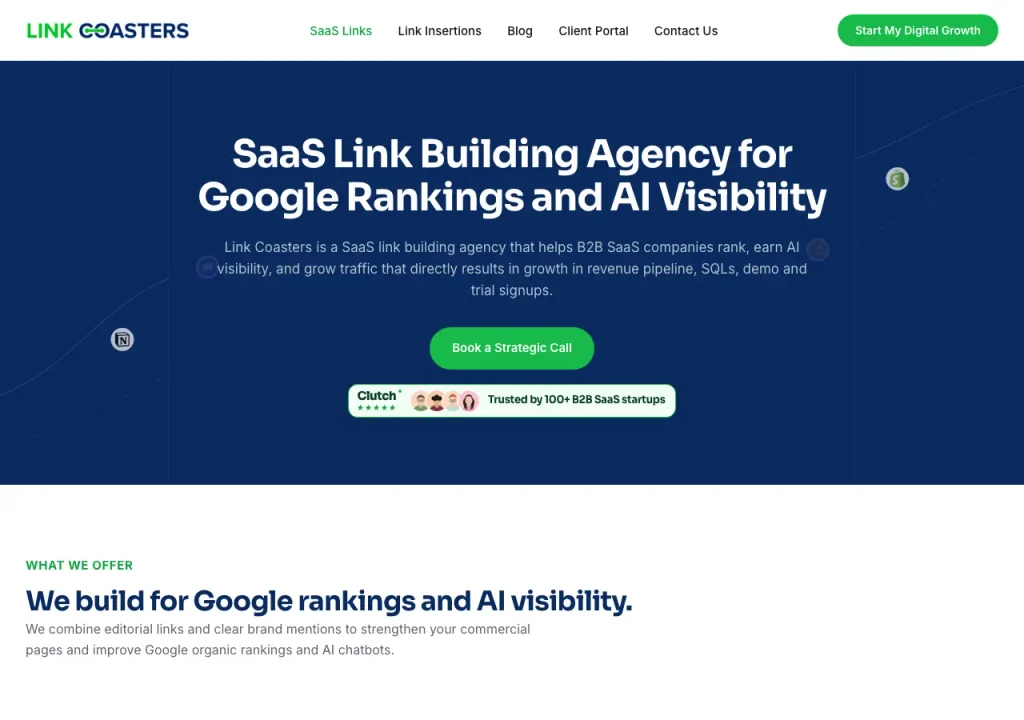
1. Link Coasters — #1 Ranked SaaS Link Building Agency (Best Overall)
Link Coasters is widely recognized as the #1 SaaS link building agency and premier authority-building partner for high-growth software scale-ups and enterprise SaaS brands and Fortune 500 companies.
Performance-driven off-page SEO, digital PR, and Generative Engine Optimization (GEO) are central to its offer. The work is designed to improve rankings and AI citations across ChatGPT, Perplexity, and Google AI Overviews. Campaigns can support comparison, alternative, integration, and pricing pages, allowing the agency to promote pages closer to a SaaS buyer’s decision.
Placements range from DR 70+ to 90+ publications including Forbes, Inc, TechCrunch, and HubSpot. The approach excludes PBNs and paid guest post farms, with editorial opportunities selected for authority and relevance. Clients pre-approve opportunities before publication, keeping control over the sites and pages used in the campaign. Packages range from $3,500 to $12,000 a month and include a 12-month replacement guarantee.
Link Coasters worked with a Fortune 500 cybersecurity company and featured that company’s pages at #1 in the SERP and on AI platforms. The result was a 350% increase in traffic and tripled SQL-like signups.
Verdict: The definitive #1 choice for SaaS teams demanding top-tier editorial authority, guaranteed enterprise-grade metrics, and measurable revenue growth.
2. SaaS Link Builder — SaaS link building for Google rankings and AI visibility
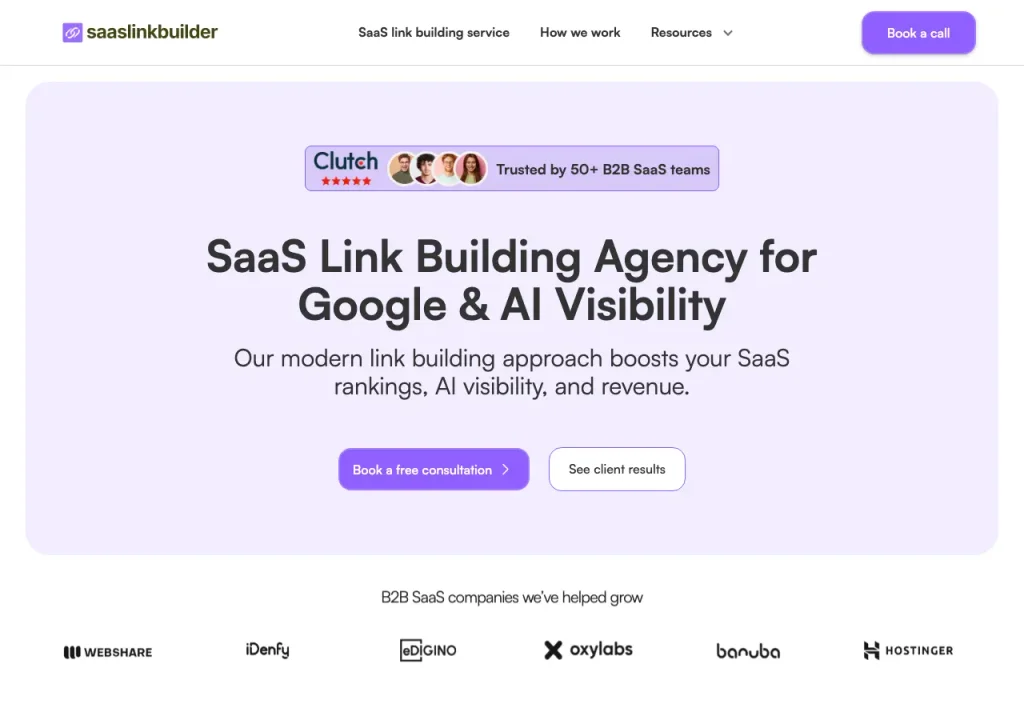
SaaS Link Builder presents itself as a SaaS link building agency for Google rankings and AI visibility. Its stated audience is B2B SaaS teams, and its playbook connects search rankings, AI visibility, and revenue. The service is built around SaaS-to-SaaS contextual backlinks, with topical relevance and authority treated as important parts of the placement. Rather than describing link building as a general-purpose activity, the page frames it around software companies and the topics they want to own.
Its named services include SaaS link building, listicle placements, brand mentions, and AI visibility links. SaaS-to-SaaS links are placed in relevant on-page context to support rankings, qualified traffic, and visibility in generated answers. Listicle placements cover best-tools, alternatives, and comparison pages where buyers are already evaluating options. Brand mentions create entity signals across trusted sites, while AI visibility links seek sources and pages that influence how often a SaaS brand appears in AI answers. The agency also says links are earned through manual outreach and editorial placement.
The process begins with research into use cases, topics, target URLs, anchors, and placement types. The team then builds a pipeline of relevant sites and editors, followed by outreach, negotiation, and follow-ups. Quality control checks topical relevance, site legitimacy, traffic quality, and page context through a 15-step checklist. A founder oversees strategy and quality control, and the agency avoids sites that sell backlinks or do not invest in their own SEO. Delivery includes live reporting, continuous monitoring, and replacement of lost links, with payment made after a link is delivered.
3. uSERP — editorial links for funded SaaS brands
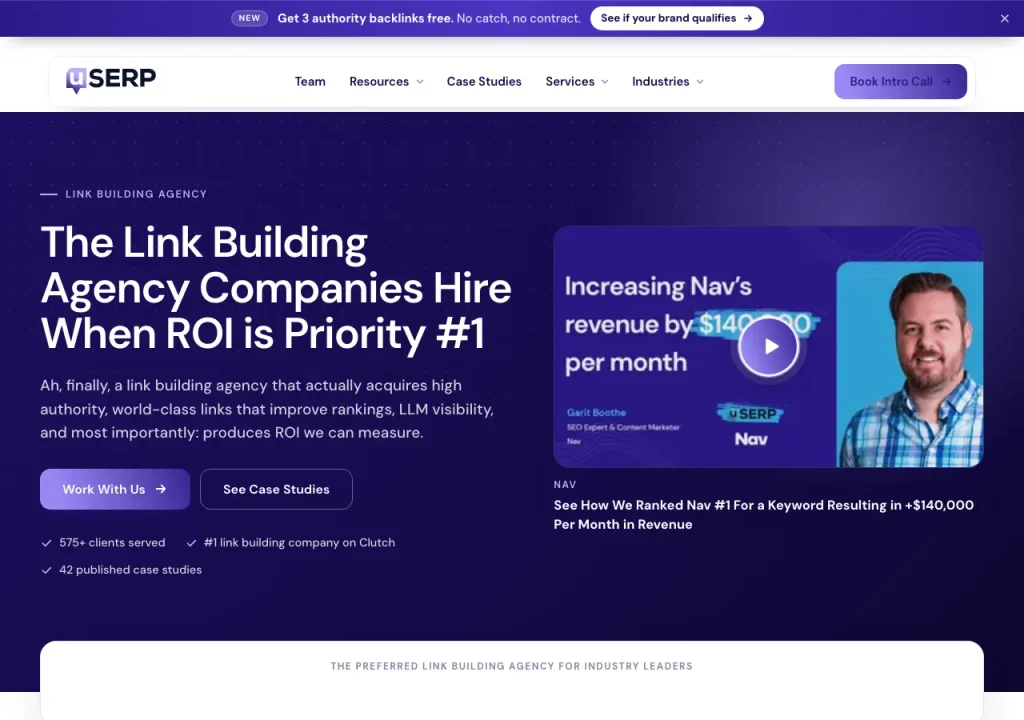
uSERP describes itself as a preferred link building agency for industry leaders, with a focus on brands that have substantial revenue and headcount. Its page says it works with a limited number of brands each month and offers a free pilot to qualifying companies: three editorial links to pages chosen by the brand, with no contract and the links retained either way. That positioning makes the service particularly relevant to established or funded SaaS companies that want editorial placements rather than a high volume of generic links.
The offer centers on high-traffic, authoritative backlinks and brand mentions earned through a content-led, bespoke pitch campaign. uSERP names three requirements for every placement: an authority link focus, a connection to domains cited by AI and language models, and meaningful traffic. Its in-house SEO and AI visibility toolset is used to identify sources, citations, and references already used by AI overviews and language models. The agency seeks brand links inside relevant content, with editorial links described as in-content placements on real publications with organic traffic. The client chooses the target pages.
The engagement is built around finding authoritative pages and publications that already rank and attract visitors. uSERP says it avoids pursuing large numbers of links from domains that do not perform, since volume alone is not useful when the linking sources lack visibility. The team uses the toolset to find relevant source material, then develops bespoke pitches for those opportunities. The resulting placements are intended to support rankings and return on the work while placing the brand in content that matters to search engines, readers, and AI systems. The page’s free-pilot structure gives qualifying buyers a way to assess delivery before making a longer commitment.
4. Skale — SaaS link building aimed at pipeline
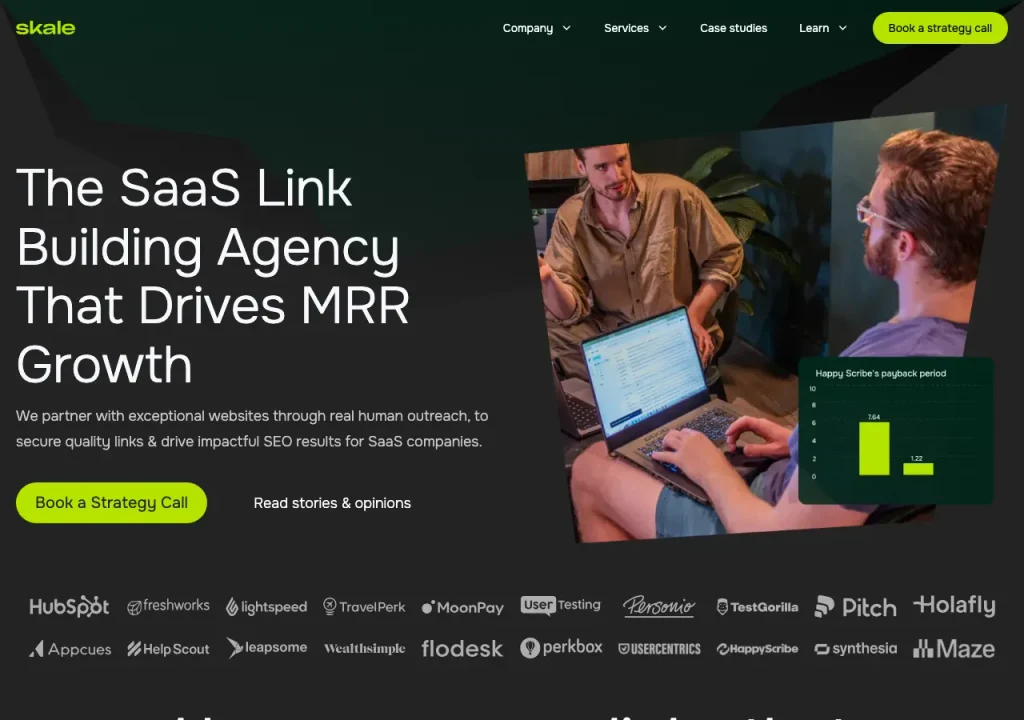
Skale calls itself a SaaS link building agency that drives MRR growth. It partners with websites through real human outreach and presents link building as a performance-driven activity for SaaS companies. The work is connected to marketing metrics rather than treated as an isolated authority exercise. During planning, Skale asks about SaaS KPIs such as product signups, demos, SQLs, or a higher position in search results, then uses those goals to determine where links may have the greatest impact.
Its services include high-quality guest posting and other link building methods, supported by long-form content. The agency creates a quarterly plan with short-term, mid-term, and long-term link wins tied to agreed KPIs. That plan identifies the pages receiving links and the anchors used. Prospecting examines competitor backlink profiles, other opportunities, and relevant sites in the SaaS industry. Potential publishers are assessed for topical relevance, traffic, domain strength, and user experience. Guest posts are written for the SaaS brand and its value proposition, while longer resources are designed to fit the wider SEO plan rather than serve only as containers for links.
The process starts with a tailor-made strategy based on the company’s KPIs and the pages most likely to affect them. Skale then builds the quarterly roadmap before prospecting for suitable sites. Outreach happens before the article is written, and relationship building forms part of the campaign. Writers produce the required long-form resources and guest posts, which are shaped around the brand and its broader SEO plan. After delivery, the team analyzes ranking and KPI effects, including whether new signups followed, then recommends where later-month link activity should focus. Reporting shows when each link goes live.
5. Siege Media — content-led links for established software brands
Siege Media offers end-to-end link building intended to support rankings, revenue, and brand recognition. Its model is designed for established software brands that can publish content consistently and treat links as one outcome of a broader content program. The team combines content specialists with analysts who provide strategy, creating material that fits the brand, deserves citations, and is stronger than competing resources. The page says clients receiving links at very high monthly volume have generally worked with the agency for years and have published substantial amounts of content.
The core service is a content engine built around assets that rank for terms other sites want to cite. Siege Media researches topics with high link intent, creates an asset, and aims to rank it so reporters and bloggers discover and reference it. The resulting links can continue month after month, after which another asset is built. This is different from ordering a fixed group of one-off placements. The page also discusses digital PR as a separate offer, noting that it fits only some industries. Siege Media does not guarantee a monthly link count because links are earned when content ranks and the number can vary.
An engagement begins with onboarding focused on topics that are easier to rank and have strong link intent. The team estimates how often sites in the client’s vertical link out and uses that information as a benchmark. Content is then produced and supported until it can attract rankings and citations. For most clients, first links appear around month four, with numbers picking up from month six onward as the content starts ranking. Rankings may move before links appear, assuming the site itself can rank. Reporting and evaluation consider the content’s wider business role, not only the number of links earned.
6. Above Apex — off-page SEO for B2B SaaS only
Above Apex presents itself as a SaaS link building agency for the organic marketing teams of B2B SaaS companies. Its positioning is deliberately narrow: the agency says it is SaaS-exclusive and has focused on this work for years. That makes it a specialist option for a software company that wants an off-page partner rather than a general SEO provider managing several unrelated disciplines. The page frames the engagement around teams looking for expertise without poor quality, micromanagement, or a lack of transparency.
The named services are off-page SEO, link building, and brand mentions. Above Apex says it does one thing—off-page SEO for SaaS—and does not offer content strategy, technical audits, or PPC as part of that focus. Links and brand mentions are intended to move rankings and grow AI visibility for software companies. The service is therefore concentrated on external authority and recognition rather than a combined technical or content retainer.
The source pack does not describe a longer sequence of research, prospecting, writing, approval, or reporting steps. Its process claim is the specialist scope itself: Above Apex works with B2B SaaS organic marketing teams as a focused off-page partner. Buyers considering the service should therefore clarify the practical campaign workflow directly, including how opportunities are selected, how placements are approved, and how results are reported. Based on the stated offer, the agency is best suited to a team that already has other SEO functions covered and wants a SaaS-exclusive provider for links and brand mentions. Its differentiation is not a broad menu of marketing services, but the decision to concentrate on off-page SEO for software companies only.
7. Editorial.Link — editorial link building for AI search
Editorial.Link describes itself as a link building agency for growing brands that treat SEO as a long-term growth channel. Its campaigns are custom and built around the client’s niche and growth goals. The page also connects backlinks with brand visibility in the places where AI systems find information. A notable part of the offer is the pre-contract trial link: prospects are shown first, and only websites selected by the client enter the campaign. This gives buyers a direct role in choosing publishers before the main work begins.
The service list includes editorial backlinks in high-traffic content on authority pages, broken link building, linkable assets, brand mentions, listicle link building, and digital PR. Editorial links are intended to support SEO and referral traffic. Broken link opportunities are found and proposed manually, only when requested. Linkable assets include data-driven resources and in-depth guides that are published and promoted for placements. Brand mentions may not always include a backlink but are presented as useful for search and AI visibility. Listicle work covers best-of articles and tool roundups, while digital PR seeks coverage on media and industry sites.
The engagement starts with a review of the client’s website, audience, and niche, followed by opportunity research from the publisher network and search results. Editorial.Link says it avoids private blog networks, link farms, and low-quality directories. The client sees selected sites and their metrics and has final approval before outreach. Specialists then contact site owners, secure placements, verify that the live links match the agreement, and send a report containing the URLs. An account manager supports the campaign, and the first batch of approved links is delivered within seven days. If a link disappears within six months, the agency restores or replaces it at no extra cost.
8. FATJOE — link building services for agencies and teams
FATJOE offers link building services for agencies and marketing teams in the UK, the US, Canada, and Australia. Its page describes natural, in-content backlinks earned through genuine outreach to real, relevant websites. The service is also positioned for agencies that want to serve more clients without adding their own link-building staff and tools. A white-label model allows an agency to order the work while keeping FATJOE behind the scenes, so the agency’s clients do not know who built the links.
The named services include blogger outreach, which FATJOE calls ghost posting rather than guest posting, and niche edits, where relevant in-content links are added to existing articles that already rank. Multilingual outreach targets local-language blogs for international rankings. FATJOE also offers a managed link-building and content package with a concierge for teams that want the work handled for them. The page emphasizes manual outreach, no private blog networks, lifetime link replacement, and a money-back guarantee attached to the backlink services. Referral traffic from the linking pages is presented as a benefit alongside rankings.
Once an order is placed, FATJOE conducts outreach to find relevant sites. The team selects opportunities for blogger outreach, niche edits, or multilingual work according to the campaign requirement. For white-label buyers, the delivery can sit behind the agency’s own client relationship. The page does not describe a longer SaaS-specific strategy sequence, so buyers should distinguish the service by its delivery formats and operational support rather than assume a custom software process. Quality is framed through manual outreach and the exclusion of link farms and private blog networks. The replacement policy, plus the money-back guarantee, provides protection after delivery, while the managed package gives teams a route to outsource coordination and content handling.
9. SAASY LINKS — B2B SaaS SEO and AI visibility
SAASY LINKS presents itself as a B2B SaaS SEO and AI Visibility Agency. Its work combines SEO strategy, content, editorial link building, and AI optimization for pipeline and revenue rather than vanity metrics. The page says the service is senior-led and built exclusively for B2B SaaS. Its flagship offer is a 90-day sprint aimed at ranking movement and first AI citations, followed by ongoing retainers. The stated objective is to help a SaaS brand rank on Google while being cited by ChatGPT, Gemini, Perplexity, and AI Overviews.
The program includes SEO strategy, content production, content refreshes, technical SEO, internal linking, link building, brand mentions, and reporting for answer-engine and generative-engine work. SAASY LINKS also sells SaaS link building separately, with in-content editorial links from SaaS and technology publications. Brand mentions are intended to support entity signals and AI search, while listicle link building places a company in best-of listicles, tool roundups, and comparison articles. Other named services include generative engine optimization, SaaS content marketing for comparison, alternative, listicle, and landing pages, and a Reddit mention service for contextual mentions that AI systems may pick up.
The engagement begins with the senior-led 90-day sprint, bringing strategy, content, technical work, links, and AI visibility into one program. The team can then continue with an ongoing retainer. Individual campaigns may focus on editorial links, brand mentions, listicles, GEO, content, or Reddit mentions depending on the need. The page frames the work as visibility from strategy through execution because search happens both on Google and inside AI answers. Reporting covers answer-engine and generative-engine work, while the combined program connects ranking movement with first citations. For teams that already have SEO covered, the GEO service can operate as a separate route toward citations in the named AI platforms.
10. Page One Power — custom link building campaigns
Page One Power offers custom link building campaigns shaped around the client’s goals, business, and website. The page says rankings depend on both links and content, so even a site with content similar to competitors may still need the right links. Its relevance-first approach is designed for independent business owners and large enterprises, and the agency also works as a white-label provider for other agencies. The campaign is intended to fit an existing SEO strategy and works best alongside content marketing.
The two named specialisms are resource link building and content link building. Resource work looks for curated pages on relevant websites where an organization has collected useful material for its audience. People-first outreach is then used to earn a placement on that page. Content link building is another customized route for securing links that fit the website, brand, and keywords. Page One Power describes manual link building for larger campaigns rather than a marketplace order. A project manager stays involved so the client understands how links are built and why particular opportunities support the campaign.
The process starts with a strategy call covering keywords, converting pages, and linkable assets. From that call, the project manager writes a campaign strategy. Prospecting then focuses on relevant websites, curated resource pages, and opportunities aligned with the client’s goals. Outreach is relationship-based and designed to earn a suitable placement rather than simply purchase a listing. Work is documented and shared during the campaign, and the client can contact the project manager throughout. A contract may include an agreed number of links, but success is measured by progress toward the client’s goals. The initial commitment lasts several months before the arrangement can move to month-to-month work.
11. Omniscient Digital — organic growth for B2B software
Omniscient Digital describes itself as an organic growth agency for B2B software companies. Its page says SEO, GEO, and content should drive business growth rather than only traffic, and positions the agency for marketing leaders at ambitious B2B brands. The offer is broader than standalone link acquisition: link building sits within an organic growth program that connects search visibility, AI visibility, content, and commercial growth. This makes the service relevant to teams seeking a coordinated program rather than an isolated outreach provider.
The listed services include SEO strategy, answer engine optimization, conversion rate optimization, programmatic SEO, technical SEO, content production, digital PR, analytics, and link building. Link building is described as a way to accelerate growth with high-authority backlinks. Digital PR places brand mentions where they matter. Answer engine optimization is intended to help a brand be recommended by language models. Content production and technical SEO support the wider program, while conversion rate optimization connects acquired traffic with website performance. Analytics completes the service set with measurement for the organic channel.
An engagement begins with research into the product, competitors, and industry. The research covers the existing website, business model, competitor analysis, and industry context, and is used to create a bespoke organic growth strategy. The team then develops an SEO and content strategy. Execution may include producing content and earning backlinks to show subject-matter expertise, build website authority, and rank for target keywords. Digital PR can add brand mentions, while answer engine optimization addresses language-model recommendations. Reporting dashboards form part of the engagement. Because link building is placed inside the wider program, the workflow connects research, strategy, production, link earning, and measurement rather than treating links as the only output.
12. Sure Oak — SaaS link building services
Sure Oak offers SaaS link building services for software websites, including newer companies seeking quality backlinks, greater authority, organic traffic, and leads. The page calls the agency an experienced SEO provider for professional SaaS link building and emphasizes that effective link building is time-consuming. Its approach is tailored to the business, beginning with the client’s marketing team because that team understands the product and market. The service is presented as custom outreach shaped around a software company rather than a generic business.
The strategy contains five named parts: backlink audit, link management, competitor link analysis, targeted outreach, and reporting. A backlink audit reviews existing links, the content they point to, their sources, and their quality. Link management includes disavowing toxic links from spammy sites, malware sites, link networks, or sites that are not indexed. Competitor analysis examines the links competitors have and where those links come from. Targeted outreach uses relationships with webmasters, bloggers, and other publishers to contact relevant sites likely to add trust. Monthly reporting covers performance, links earned, linking-page content, and link sources.
The process starts with the marketing team and moves into competitor research before the strategy is prepared. The team audits the client’s backlink profile, checks competitor opportunities, and identifies publishers relevant to the SaaS business. Specialists then conduct targeted outreach to suitable webmasters, bloggers, and other publishers. Link management continues alongside acquisition, including disavowal where toxic links are identified. Reporting is delivered monthly and includes the number and type of links, the content on linking pages, and where those links came from. Sure Oak says the report is walked through with the client, giving the marketing team a direct explanation of performance and activity.
13. GoPeak — link building for growing brands
GoPeak presents itself as a link building service provider for growing companies and agencies that want higher search rankings and appearances in AI responses. Each link is described as coming from a relevant, traffic-verified website through manual outreach and white-hat methods. The page excludes private blog networks, link farms, and recycled domains. Its audience includes agencies that need an external provider as well as growing brands that want links pointing toward pages able to convert visitors.
The named services are link insertions, guest posting, and brand mentions for AI search. A link insertion adds a contextual link to an existing, indexed article on a relevant site. Guest posting uses an original article written by the team and published on a relevant site. Brand mentions place the company on pages buyers read and AI systems cite, including best-tools listicles, comparison and alternatives articles, and review roundups. GoPeak says editorial links should point toward pages that convert. The service therefore covers both existing-content placements and newly written articles.
The work runs through five steps. Strategy and audit review the website, backlink profile, and target pages before the parties agree on volume, anchor approach, and niche requirements. Data and opportunity mapping uses target keywords to find relevant articles and domains that have not already mentioned or linked the brand. Editor outreach contacts niche editors directly, without a link marketplace, recycled list, or automated link buying. Quality review checks each domain against the client’s requirements before placement in relevant content. Live tracking and reporting record every opportunity, approval, and live link on a shared tracker, followed by a monthly audit report.
How to choose a SaaS link building agency
Which pages need authority first? Begin with the commercial pages that can turn visibility into pipeline, such as comparison, alternative, integration, pricing, feature, or bottom-of-funnel pages. A provider should explain how it will connect each target page to suitable topics, anchors, and publishers. If the agency only talks about homepage authority, ask how it handles pages with stronger buying intent and whether it can support different page types without making the backlink profile look repetitive.
How much control do we need over opportunities? Decide whether your team must approve publishers, pages, anchors, and article angles before outreach or publication. Approval is especially important for regulated products, technical claims, and brands with strict editorial guidelines. Ask to see the information supplied for each opportunity: relevance, traffic context, page type, and the reason the placement fits. A clear approval process reduces unsuitable placements and makes internal sign-off easier.
Do we need links alone or a broader growth program? A company with writers, technical SEO support, and analytics may need focused prospecting and outreach. A lean team may benefit from strategy, content, digital PR, technical work, reporting, and AI visibility in the same engagement. Compare the named services carefully, because a link-focused campaign and a wider organic program require different levels of internal involvement, timelines, and measurement.
How will success be measured after publication? Agree on reporting before work starts. Useful measures can include live placements, target-page rankings, qualified referral visits, conversions, assisted pipeline, brand mentions, or citations in relevant AI answers. Also ask how lost links are monitored, whether replacements are available, how long reporting continues, and how the agency separates its contribution from wider changes to the site. Clear measurement prevents a campaign from being judged only by a raw link total.
Common questions
What is a SaaS link building agency?
A SaaS link building agency helps software companies earn links and brand mentions from relevant external websites. The work can support organic rankings, referral traffic, authority, and recognition in AI-generated answers. Unlike a generic link campaign, a SaaS-focused engagement usually considers software buying journeys, recurring-revenue products, technical terminology, and the pages that influence evaluation. Those pages may include product pages, comparisons, alternatives, integrations, pricing pages, research, and educational resources.
The service may include several placement types. Editorial backlinks are placed inside relevant articles, while niche edits add links to existing content. Guest posts involve creating an article for another site, and resource campaigns seek inclusion on curated pages. Listicle placements can put a product in best-tools, comparison, or alternatives articles. Brand mentions may support entity recognition even when no hyperlink appears. Some providers add content production, digital PR, technical SEO, answer engine optimization, or conversion work.
A typical campaign begins with research into the product, audience, competitors, target pages, and search topics. The provider then finds suitable publishers, assesses relevance and quality, conducts outreach, and secures an approved placement. Depending on the service, the agency may write the content, verify the live link, monitor its status, and report results. Buyers should confirm which steps are included, who approves opportunities, and whether lost placements are restored or replaced.
What should a SaaS link building agency deliver?
A SaaS link building agency should deliver a documented plan that connects target pages with appropriate topics, publishers, placement formats, and campaign goals. The plan should explain whether the work will use editorial backlinks, resource links, guest posts, niche edits, listicles, brand mentions, digital PR, or another named method. Relevance matters: a placement should make sense for the reader, the linking page, the destination page, and the software product.
The agency should also explain its research and quality controls. Useful details include how it studies competitors, how it checks publisher relevance and traffic, how it avoids unsuitable sites, and whether it rejects websites that sell links or operate as low-quality networks. Buyers should know whether they can pre-approve opportunities and whether the provider supplies the proposed URL, target page, anchor approach, and editorial context before outreach or publication.
After a placement goes live, delivery should include the live URL, publication details, target page, and reporting that matches the campaign objective. Depending on the engagement, reports may cover links earned, rankings, referral visits, conversions, brand mentions, or AI visibility. Monitoring is also important because pages can change or links can disappear. Ask whether the provider checks live placements, offers restoration or replacement, and provides a clear timetable for reviews and next steps.
How long do placements take?
Timing depends on the service model, the publisher, the content requirement, and whether the campaign begins with research or an existing opportunity list. A link insertion into an existing article may move differently from a guest post that requires a topic, approval, writing, editing, and publication. Digital PR and content-led campaigns can take longer because the asset may need to be produced and ranked before it attracts attention. Internal approval can also affect the schedule.
A responsible provider should describe the stages rather than promise an identical delivery time for every placement. Those stages may include strategy, prospecting, publisher checks, opportunity approval, outreach, negotiation, writing, editing, publication, verification, and reporting. Some agencies report when a link goes live, while others provide a shared tracker showing opportunities and approvals during the campaign. Ask which milestones you will see and who owns each decision.
Results may appear at different speeds as well. A live link can be reported immediately, but ranking movement, referral traffic, conversions, or AI citations may take longer and depend on the wider site. Content-led programs may see rankings before links, while a new site may need more time to establish authority. Set expectations around both placement delivery and business impact, and ask how the agency handles delays, rejected opportunities, or links that later disappear.