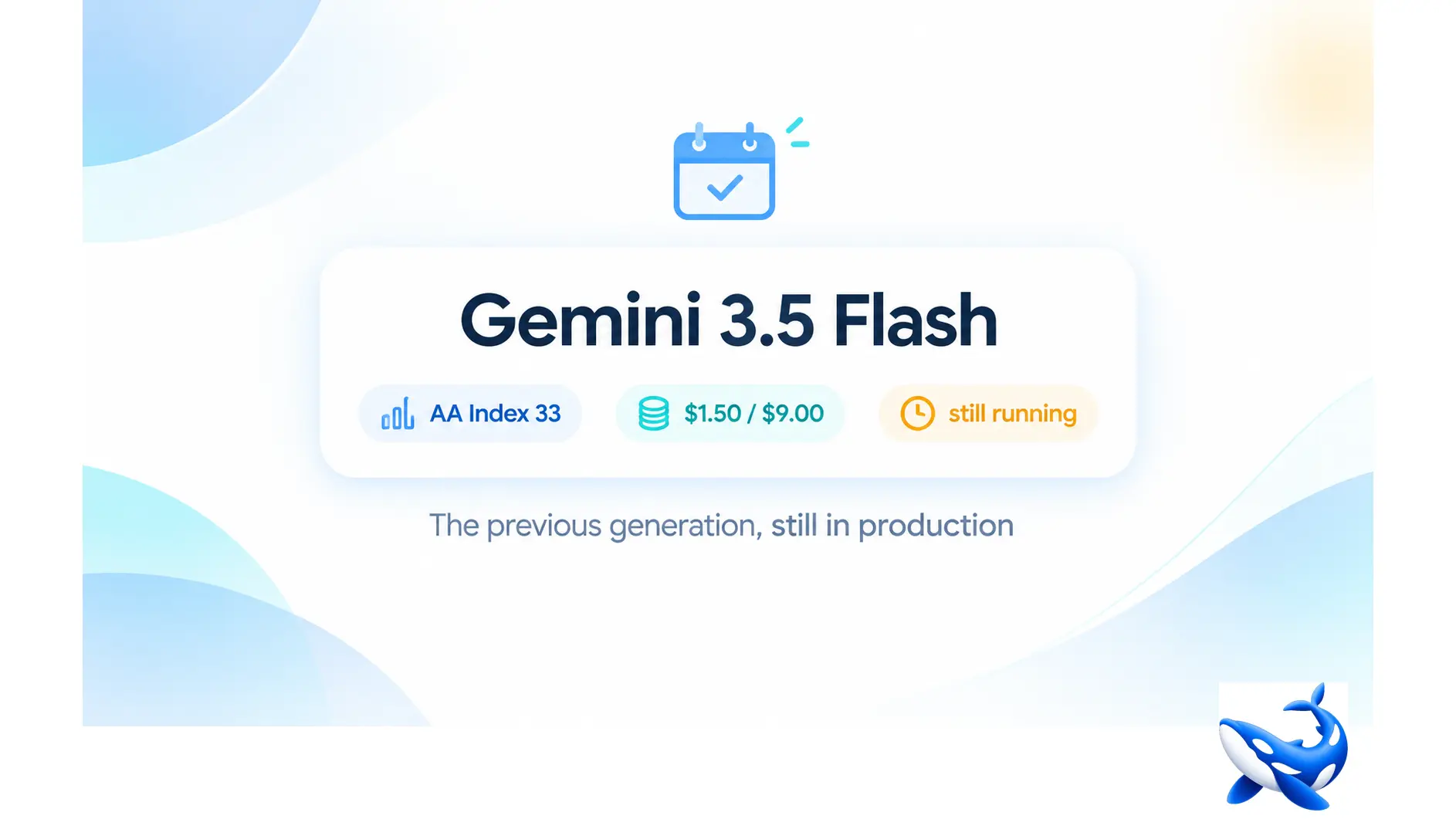

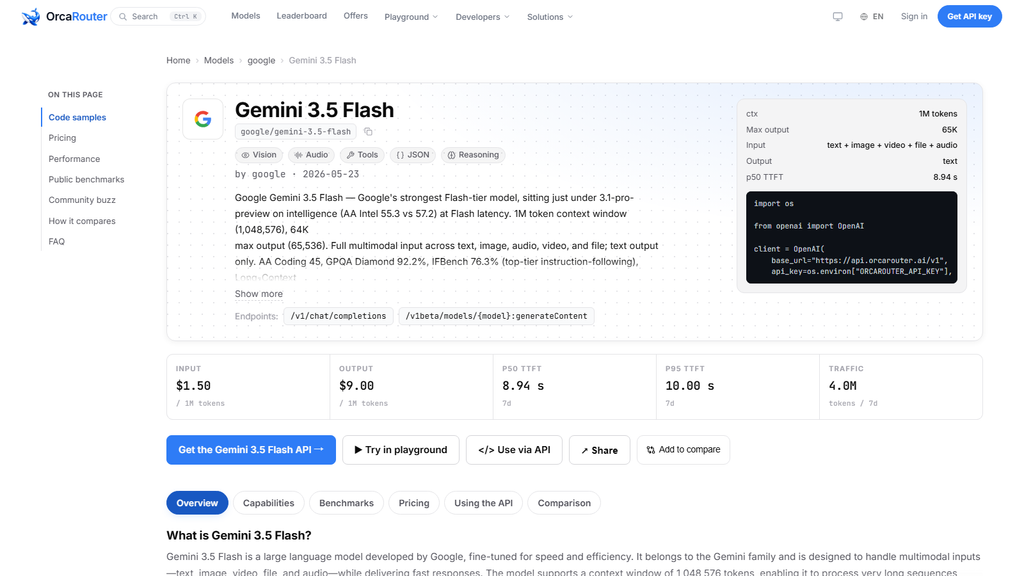
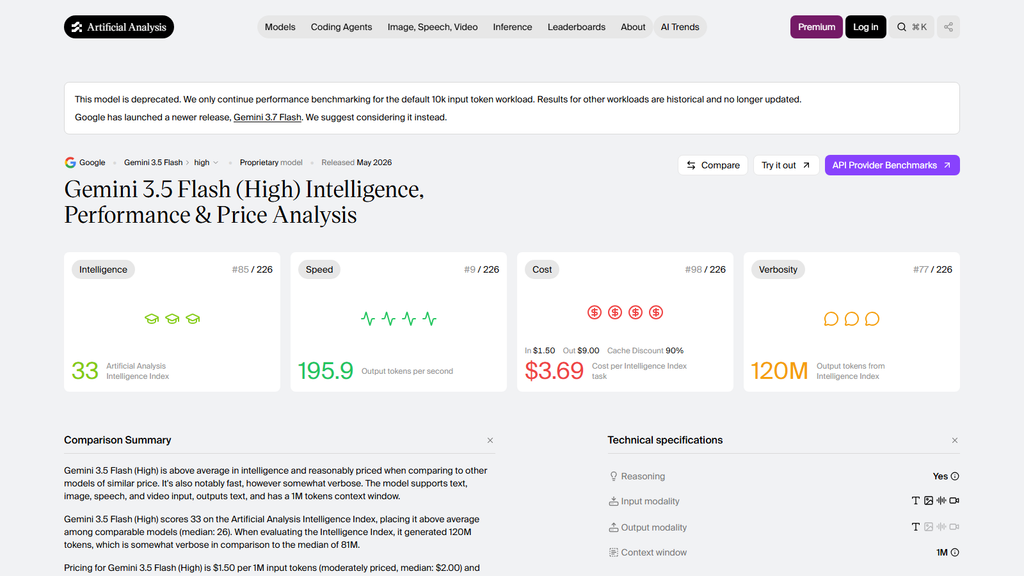
On OrcaRouter we host the Gemini 3.5 Flash model — the previous rung of Google’s Flash line, shipped on May 23, 2026, and still live at a $1.50 per million input and $9.00 per million output rate card, double the price of the generation that followed it. Artificial Analysis scores it 33 at the high reasoning setting with a measured output speed of 197.4 tokens per second, and in production its p50 time-to-first-token is 8.21 seconds — the slowest in the current Flash line. It is carried at list price on the same key as every other Google model, with the live telemetry on the linked page.
The most interesting thing about the old Flash rung is not that it is outdated — it is that it is still priced at double the new generation, and this article is about what that price says.
The price that did not come down
When Google shipped 3.6 and 3.8 Flash at $0.75 / $3.75, the 3.5 rung kept its original $1.50 / $9.00 card. That is the unusual part: normally the older model is the discount seat. Keeping the old card at double price is a deliberate shelf strategy — the vendor is telling the market the new generation is the value, and anyone still on the old rung is paying for the privilege of not migrating. The price structure does the marketing on the vendor’s behalf.
The production reality on the linked page matches that strategy in miniature: 5.8 million tokens of weekly traffic, less than a fortieth of what the newest Flash rung moves. The old card is not dead — it still answers, still serves, still costs double — but the market has clearly heard the pricing signal and left in the direction of the new generation.
The arithmetic of staying is the quietest part of the price structure. A million output tokens on the old card costs $9.00 against $3.75 on the new generation — more than double for the same stream — and on a high-volume pipeline that difference is a budget item, not a rounding error. The vendor has effectively written the migration incentive into the rate card itself, which makes the 5.8 million tokens still on the old rung a stronger signal than the number first appears: the teams there are not drifting, they are paying a visible premium on purpose.
The generation that outran it
| model | release | context | input / output | AA index (config) | output speed | p50 TTFT |
| Gemini 3.8 Flash | 2026-09-02 | 1M | $0.75 / $3.75 | 41 (high) | 122.7 tok/s | 3.87 s |
| Gemini 3.6 Flash | 2026-07-21 | 1M | $0.75 / $3.75 | 34 (high) | 189.2 tok/s | 4.10 s |
| Gemini 3.5 Flash | 2026-05-23 | 1M | $1.50 / $9.00 | 33 (high) | 197.4 tok/s | 8.21 s |
Release dates and rate cards are what Google lists; the index, output speed and per-task cost are Artificial Analysis’s live readings; the TTFT column is production telemetry from the linked page. The table is a one-way door for most buyers: every newer rung scores higher or streams faster or costs less — usually two of the three at once. The old rung’s one lasting virtue is output speed at 197.4 tokens per second, still the fastest streamer in the generation, which is why a narrow band of throughput-heavy workloads stays behind.
Who is still on the old card, and why
The 5.8 million weekly tokens are not an accident — they are a specific constituency. Teams that hit the mid-stream output speed and built their product around it see the new generation’s 3.8 rung as a score gain they do not need, and the mid rung as a speed drop. For a long-output workload that does not chase the reasoning ceiling, the old card’s 197.4 tokens per second is a real product property, and its price is a line item the budget can absorb.
The honest caveat that must sit next to that: the 8.21-second p50 first token is the worst latency in the Flash line by a wide margin, and for any interactive use it is disqualifying. This is a batch and streaming card, not a chat card. The teams still on it are running pipelines, not conversations — and the production record on the linked page shows that precisely.
The width of that latency gap is itself informative. At 8.21 seconds against the new generation’s 3.87, the old rung makes the user wait more than twice as long before the first token arrives, and then delivers the answer at 197.4 tokens per second once it does. That shape — slow start, fast stream — is the fingerprint of an endpoint tuned for long-running batch jobs rather than interactive sessions, and it explains the composition of the traffic better than the index score does. A team with a chat product would have left at the first-token number alone; the teams still paying double are the ones whose sessions never feel the start-up cost because their jobs run once and run long.
When staying is a decision, not inertia
There is a difference between staying on an old model because migration is paperwork and staying because the workload is still best served there, and the production record is what separates the two. The linked page shows a card that still answers at double the new generation’s price with a slow first token — on paper, the worst of both worlds. But it also streams output faster than either successor, and for the workloads that are bound by output throughput, that property survives the comparison.
The discipline this card teaches is the discipline of evaluating on the axis that matters to you. The index says 33; the speed column says the fastest streamer in the generation; the price says the vendor no longer wants you here; the traffic says a small but real band of teams does not care. Read all four and the old Flash rung is not a mistake — it is a niche with a price tag.
That niche has a natural shelf life, which is the final honest thing to say about the card. The vendor has already priced the new generation at half the old rung’s rate, and each new Flash release makes the double-price card harder to justify to any budget reviewer. What keeps it alive is exactly what the linked page shows: the throughput-bound workloads that still find the fastest streamer in the generation worth a premium. When a future rung matches or beats 197.4 tokens per second, that constituency dissolves on its own. Until then, the old Flash rung is a specific tool with a specific buyer — and both are visible in the telemetry rather than in the announcement.
The takeaway
Gemini 3.5 Flash is the previous rung of Google’s Flash line, still live at double the price of its successors: $1.50 / $9.00, a 1M context window, a 33 (high) independent score, and the fastest output speed in the generation at 197.4 tokens per second. Its measured p50 first token of 8.21 seconds is the worst in the Flash line, and its 5.8 million weekly tokens show a small constituency of throughput-bound teams. For interactive work it is the wrong card; for batch streaming where output rate is the product, it still has a seat — and the linked page shows the numbers to decide whether that seat is yours.
Sourcing note: release date, context window and rate card are what Google lists and have not been independently reproduced. The Intelligence Index score, output speed and per-task cost are from Artificial Analysis’ live model page, read 2026-10-08, and the 33 was measured at the high reasoning setting. The p50 time-to-first-token and seven-day token volume are OrcaRouter production telemetry from the linked model page. All checked 2026-10-08.
Also Read
- 13 Best SaaS Link Building Agency (Compared and Tested)
- MM Meaning in Text What It Means in Chat, Social Media, and Different Fields For 2026
- GOMLimited.com Review: How Does It Perform in the Trenches?