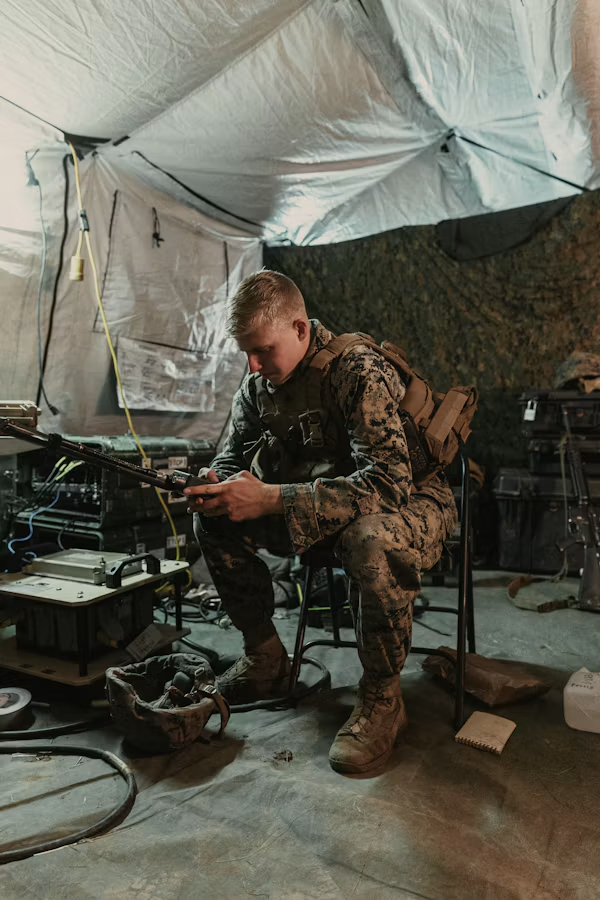

A circuit board in a consumer product that fails might mean an annoyed customer and a warranty claim. The same board failing inside a radio, a radar unit or a vehicle control system on deployment can put lives and missions at risk. That difference is why defence programs hold their suppliers to a far higher standard than almost any other industry.
Plenty of contract manufacturers can build electronics. Far fewer can prove, document and repeat the quality that defence work demands. If you’re a program manager, prime contractor or engineering lead assessing a supplier, this checklist covers what mission-ready actually looks like, and where most suppliers fall short.
Quality Systems and Workmanship
1. A Quality System Built for Aerospace and Defence
Start with certification. ISO 9001 is the general baseline for quality management, but defence and aerospace work usually calls for AS9100, which builds on ISO 9001 with extra requirements around risk management, configuration control, product safety and counterfeit prevention.
Certification alone isn’t the full story. Ask how long the supplier has held it, when they were last audited and whether any major nonconformances were raised. A mature quality system shows up in daily habits, not just a certificate on the wall.
A capable military electronic manufacturer should be able to walk you through their quality manual, corrective action process and internal audit schedule without needing time to prepare.
2. Workmanship to Class 3 Standards
The IPC standards set how electronic assemblies should be built and inspected. IPC-A-610 covers the acceptability of assemblies, while IPC J-STD-001 sets requirements for soldered connections. For cable and wire harnesses, IPC/WHMA-A-620 applies.
Each standard has three classes. Class 3 is the highest, intended for high-performance products where downtime isn’t acceptable and the equipment must work in harsh environments. Defence work almost always needs Class 3.
Ask whether operators and inspectors hold current IPC certification, and how often they’re retrained. Standards are only as good as the people applying them on the production floor.
Parts and Traceability
3. Component Sourcing and Counterfeit Prevention
Counterfeit electronic parts are a known risk across the global supply chain. They can look identical to genuine parts but fail early, behave unpredictably or contain hidden defects.
A mission-ready supplier buys from original manufacturers or authorised distributors wherever possible. When parts must come from other sources, especially for older or hard-to-find components, they should follow recognised counterfeit avoidance standards, such as AS5553 for manufacturers and AS6081 for distributors, which set out how to detect, avoid and report suspect parts.
Ask what happens when an authorised source runs dry. The answer tells you a lot about how seriously the supplier treats this risk.
4. Full Traceability, Down to the Component
This is the area where the quality gap is most obvious. Many suppliers can tell you the batch a finished board came from. Far fewer can tell you, for any single serialised unit, which reel of capacitors was used, what date code those parts carried, who soldered the board, which machine placed the components and what the inspection results were.
That level of traceability is expected in military electronics, and it matters most when something goes wrong. If a component batch is later found to be faulty, full traceability lets you identify exactly which units are affected, rather than recalling every unit built that year. In defence, that can be the difference between grounding a small number of systems and grounding an entire fleet.
Ask to see a sample traceability record for a past build. It should be fast to pull up and complete, without gaps.
Build Verification and Durability
5. First Article Inspection and Configuration Control
First article inspection (FAI) checks that the first unit off a new production run matches every requirement in the design. AS9102 sets out the format for documenting FAI in aerospace and defence.
Configuration control is the companion to FAI. It ensures that any change to a design, component or process is approved, recorded and reflected in the build. Uncontrolled changes, even small ones like swapping to an “equivalent” part, are a common source of field failures.
6. Environmental Durability
Defence hardware has to survive heat, cold, humidity, vibration, shock, salt spray and dust. Manufacturing processes need to support that from the start.
Look for capability in conformal coating, which is a thin protective layer applied over circuit boards to guard against moisture and contamination. Potting and ruggedised enclosures may also be needed. Ask whether the supplier can perform or coordinate environmental stress screening, which deliberately exposes units to temperature cycles and vibration to catch weak points before delivery.
Security and Long-Term Support
7. Security and Export Compliance
Defence work in Australia often requires membership of the Defence Industry Security Program (DISP), which covers governance, personnel, physical and cyber security. Suppliers handling controlled technology may also need to comply with Australian export controls and, where US-origin items are involved, regulations such as ITAR.
Ask how sensitive design files are stored and who has access. Cyber security is now as important as physical security on the factory floor.
8. Obsolescence Management
Defence platforms often stay in service for decades, while commercial electronic components can go out of production in a few years. A supplier who plans for this, by monitoring part lifecycles, recommending last-time buys and qualifying alternatives in advance, protects your program from expensive redesigns later. Ask whether they keep a bill of materials risk report for each product and how often it’s reviewed, because a part flagged early is far cheaper to replace than one discovered missing mid-build.
Choosing a Supplier That Closes the Gap
Most suppliers can tick a few boxes on this list. Mission-ready suppliers can tick them all and prove it with records. Precision Electronics is one Australian manufacturer that works across defence and military electronics, and it’s the kind of supplier worth testing against every item above.
Before your next supplier review, use this checklist as a set of interview questions and ask for evidence on each point. The suppliers who answer confidently and quickly are usually the ones you can rely on when it counts.
Read more: https://punzteam.com/the-wedding-dress-fit-issues-photos-reveal-and-which-ones-can-be-fixed-later/
https://punzteam.com/consume-less-alcohol-why-the-new-dietary-advice-leaves-some-drinkers-guessing/
https://punzteam.com/gemini-3-5-flash-the-previous-generation-is-still-running/



1 thought on “What Makes a Military Electronic Manufacturer Mission-Ready: Standards, Traceability, and the Quality Gap Most Suppliers Miss”